
Dental Implants in Edgware
What is a dental implant?
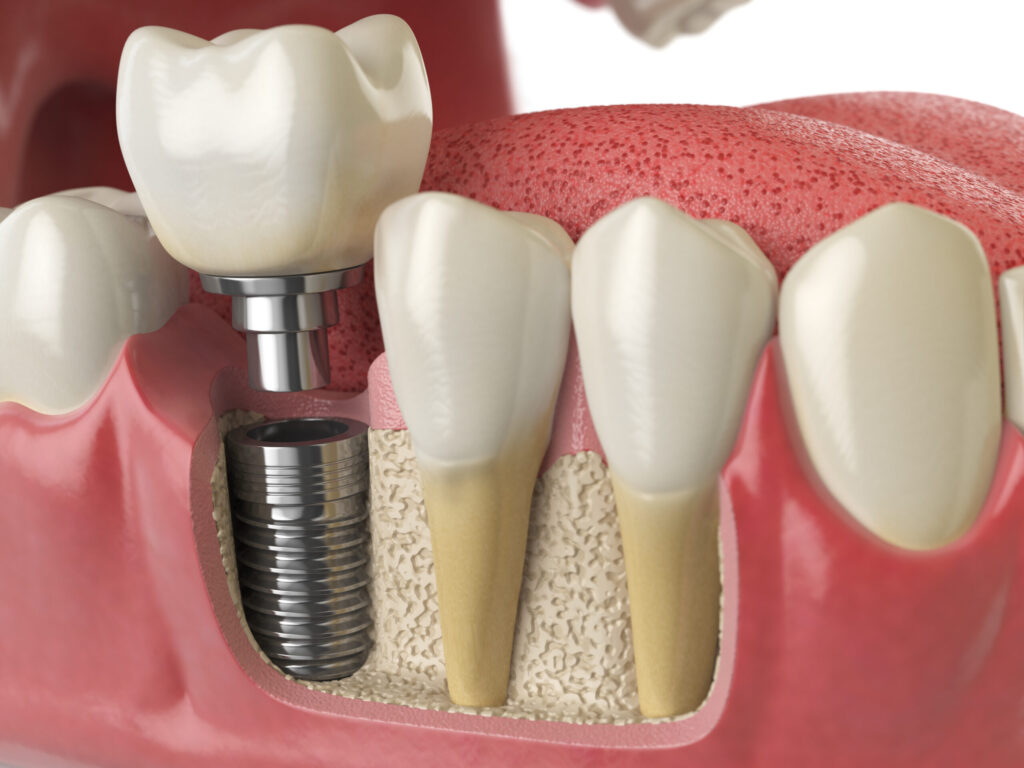
A dental implant is a small man-made titanium screw that serves as the replacement for the root portion of a missing natural tooth. The implant is placed in the bone of the upper or lower jaw and allowed to bond with the bone and serve as an anchor for the replacement tooth. Dental implants can be used to replace a single lost tooth or many missing teeth. Implant-supported replacement teeth look, feel, and function like natural teeth. Dental implants are a proven restoration option with a long clinical history. Dental implants preserve the integrity of the facial structure and reduce the inconvenience associated with tooth loss.
Single Tooth Replacement
Immediately (at the same time an implant is placed) or after a period of healing, an abutment is attached to the implant. This is a device that “abuts? or joins the implant to a tooth form called a crown. Then this will replace the tooth part you see in the mouth. It will hold a custom-made crown that the dental laboratory will fabricate and match to your existing teeth. The custom crown is cemented or screwed onto the abutment to permanently keep it in place. Once the crown is in place, it should be indistinguishable from your natural teeth.
Implant Supported Overdentures
Using dental implants to secure and stabilise full dentures has been called the ‘gold standard’ of care for lower denture wearers.
This treatment involves the fitting of between two and four dental implants. These are then attached to the dentures with special snap on connections. The dentures still need to be removed each day for cleaning however they are stable and secure without the need for messy denture adhesives. Patients find they can enjoy the food they like and socialise with more confidence
Fixed Multiple Tooth Replacement
As with single tooth replacement, temporary healing caps or abutments may be placed on multiple implants until the healing phase is complete. After healing, permanent abutments are attached to the implants. They can attach to custom-made crowns or bridgework that a dental laboratory will fabricate to match your existing teeth. In the final step, the custom bridge, which will replace multiple teeth. And cemented or screwed onto the abutments. The teeth have been replaced without disturbing the healthy teeth next to them, and bone loss has been halted.


FAQ's
You will need to see the hygienist at regular intervals following completion of your implant treatment. Like natural teeth and gums, implants need good oral hygiene and this is the key to the long term success of your dental implants. We will provide full written instructions on how to care for your implant.
The after effects of implant placement are usually very mild. There may be some slight bruising and swelling dependent on the number of implants placed; this can be relieved by painkillers. Antibiotics and mild steroids will be prescribed for your comfort. Most of our patients report little or no discomfort.
No, implant placement is a very gentle procedure, normally carried out under a local anaesthetic and in most cases a mild sedative.
The treatment is highly reliable (96% success rate in a healthy person). With routine check-ups and the following of home care instructions, they should last a lifetime.
A sinus lift will be required when there is insufficient bone in the pre-molar and molar region. Usually, the sixth tooth (first molar) in each quadrant is where the sinus is at its lowest point of the maxilla (upper jaw). It may also be referred to as ‘sinus augmentation’. The need for a sinus lift will be due to insufficient bone due to tooth loss, periodontal disease. Or natural low sinus positioning. It’s typically performed in advance of implant placement surgery. This will allow time for bone healing. But in some cases, both procedures may be done at the same time. While the need for this procedure is not uncommon, not all implants placed in this region will require it.
There can be several reasons why the amount of bone found in a patient’s upper jawbone might be insufficient to accommodate a dental implant.
They include damage to the bone due to a previous surgical procedure (like a difficult tooth extraction) or the effects of periodontal (gum) disease.
A frequent problem simply involves the situation where the size and shape of their maxillary sinus are relatively large. This is in comparison to the size of their upper jaw (as shown in our illustration above). Because of this, there is not enough bone thickness in which to embed an implant.
If you would like to find out more about Dental Implants in Edgware or the surrounding areas: